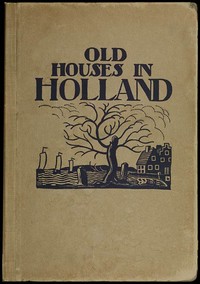
Old Houses in Holland — Text and Context

(0 User reviews)   1666
In Category - Design Photography
Jones, Sydney R. (Sydney Robert), 1881-1966, Holme, Charles, 1848-1923 [Editor] Project Gutenberg 2019 Not confirmed
Architecture, Domestic -- Netherlands Readers of public-domain and historical texts
Project Gutenberg digital edition en

Edition facts

Words 23,701
Reading time 104 min
Text sections 6

The catalog record for Old Houses in Holland — Text and Context provides practical reading context through 23,701 words, 1 hr 44 min estimated reading time, and 6 detected text sections.

The text analysis averages about 22.4 words per sentence, while the detected sections provide another way to judge how the source is divided.

Project Gutenberg metadata also associates the work with “Architecture, Domestic -- Netherlands,” connecting these edition facts with the source record’s subject description.

Explore this collection

Compare your next read

These alternatives are selected using recorded categories and estimated reading time.

Search stored excerpts and compare books → Choose by your preferences →

How these choices and excerpts are prepared

Choices use stored catalog measurements. Estimates vary with reading speed. A shared category is a catalog label, not a claim that two books have the same argument or literary quality.

Search reads excerpt text stored with this catalog and links to its associated Gutenberg record. The connection is stored in the site database; this tool does not recheck that every excerpt is word-for-word identical to that external record. Excerpt search does not cover every chapter and does not verify historical publication dates.

Catalog snapshot checked: 2026-09-25. Coverage: 93 public books, 93 available source excerpts.

An architectural study of Dutch domestic buildings, focusing on exterior features like gables, doorways, and windows, with detailed observations on materials, color schemes, and regional variations.
Share
Editorial Edition Score 4.7/5

Calculated from edition completeness, EPUB availability, text structure and catalogue metadata. Not a user rating.

How this score is calculated
  • Description quality20 pts
  • Title & short description10 pts
  • Source metadata20 pts
  • Text length15 pts
  • Chapters / structure15 pts
  • EPUB file integrity20 pts

Total of 100 points, scaled to a 2.5-5.0 range. Editions with an empty description or a missing EPUB file are not scored.

Edition quality

Public-domain source text

Read the source text

The source text is kept in the dedicated reader, separate from this catalogue record and its commentary.

Sydney R. Jones's Old Houses in Holland opens not with a sweeping historical claim but with a precise inventory of regional building materials: the low brick walls, tarred and 18 to 30 inches high, that support timber frames in North Holland. The text moves methodically from foundation to roof, noting how thatch or tiles project at the eaves. This attention to construction detail sets the tone for a work that treats architecture as a craft of local adaptation rather than abstract style.

A Methodical Eye on Materials

The author's voice is that of a patient surveyor. Descriptions are anchored in measurable facts: the height of a brick wall, the date on a keystone (1799 at Zuiderwoude), the specific shade of paint favoured in a district. On Walcheren it is apple-green and white; north of Amsterdam, bluey-green and cream; near Nijmegen, buff. The prose resists romanticising these choices, instead presenting them as practical outcomes of local tradition and available pigments. Even the treatment of timber houses at Broek, Volendam, and Marken is handled with the same evenness—boards nailed to exposed framing, coated with tar or paint. The effect is cumulative: the reader begins to see Dutch villages as a palette of deliberate, repeated decisions.

Gables, Doorways, and the Rhythm of Openings

Division II shifts focus to exterior features, and the prose becomes more analytical. Doorways are described as 'more than mere ways of access,' their enrichment making them imposing. Windows are 'similarly emphasised,' and crowning gables—crow-stepped or curved—complete the richness. The author notes 'inventive readiness and meritorious execution' in these details, but the evidence is in the dates and locations: Woudrichem (1611), Dordrecht (1702), Alkmaar (1609). The text traces a chronology of ornament without claiming a linear progression. Each example is tied to a specific town, grounding the analysis in geography rather than abstraction.

Colour as Regional Signature

One of the most striking observations concerns the 'extravagant use of paint' in both country and town. The author notes that paint is renewed at frequent intervals and well applied, covering shutters, doors, window frames, and often the whole house front. The effects are 'not unpleasing,' giving villages 'an air of gaiety and freshness.' But the key insight is the regional consistency: a district follows one general note. This is not mere decoration but a form of local identity, as systematic as the brick-and-timber construction. The text also notes a fondness for natural beauty in the layout of open spaces, with Nijmegen and Arnhem singled out for their parks and transformed fortifications.

Readers will find that Old Houses in Holland rewards a slow, attentive approach. The text is dense with specific dates, place names, and material details; skimming will miss the quiet patterns that emerge across regions. Pay particular attention to the captions of the illustrations, which often carry dates and locations that the main text uses as anchors. The book is best read as a field guide to a vanished or transformed landscape, one where paint colours and gable shapes once spoke as clearly as street signs.

There’s something so quiet about studying a row of Dutch gables—each one holds its own small history without needing to say a word. I felt that same hush reading York Minster — Edition Insights, how a building’s surfaces carry memory. It stayed with me, like light on old brick at evening. Just a lingering thought.

There are no reviews for this eBook.

0
0 out of 5 (0 User reviews )

Add a Review

Your Rating *
There are no comments for this eBook.

Reader reflection

What did you think of this book?

Answer a few questions and save a private reflection on this device.

Your progress 0 / 10
1

What is your current status with this title?

2

Did this book hold your interest?

3

Is this a title you would suggest to others?

4

What was the reading difficulty like?

Related eBooks