About 20 minutes
The story of the house — Reading Notes
Architecture
4,523 recorded words. 3 minutes difference from this book's estimate.
View Gutenberg source #67203
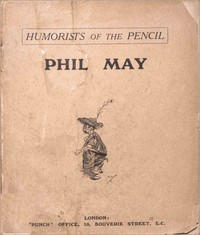
This digital edition of Humorists of the Pencil: Phil May — Text and Context is described by source-level measurements including 5,255 words, 23 min estimated reading time, and 2 detected text sections.
The text analysis averages about 13.3 words per sentence, while the detected sections provide another way to judge how the source is divided.
Project Gutenberg metadata also associates the work with “Caricatures and cartoons -- Great Britain,” connecting these edition facts with the source record’s subject description.
Explore this collection
These alternatives are selected using recorded categories and estimated reading time.
About 20 minutes
Architecture
4,523 recorded words. 3 minutes difference from this book's estimate.
View Gutenberg source #67203About 15 minutes
Architecture
3,295 recorded words. 8 minutes difference from this book's estimate.
View Gutenberg source #54809About 14 minutes
Architecture
3,192 recorded words. 9 minutes difference from this book's estimate.
View Gutenberg source #32967Search stored excerpts and compare books → Choose by your preferences →
Choices use stored catalog measurements. Estimates vary with reading speed. A shared category is a catalog label, not a claim that two books have the same argument or literary quality.
Search reads excerpt text stored with this catalog and links to its associated Gutenberg record. The connection is stored in the site database; this tool does not recheck that every excerpt is word-for-word identical to that external record. Excerpt search does not cover every chapter and does not verify historical publication dates.
Catalog snapshot checked: 2026-09-25. Coverage: 93 public books, 93 available source excerpts.
Calculated from edition completeness, EPUB availability, text structure and catalogue metadata. Not a user rating.
Total of 100 points, scaled to a 2.5-5.0 range. Editions with an empty description or a missing EPUB file are not scored.
“PUNCH” OFFICE, 10, BOUVERIE STREET, E.C.
Reproduced from “The History of Punch” by the kind permission of Mr. H. H. Spielmann, the ownder of the original drawings.
End of Project Gutenberg's Humorists of the Pencil: Phil May, by Phil May
Phil May's Humorists of the Pencil presents a series of cartoons originally published in Punch, but the excerpts reveal a specific focus on working-class London life through Cockney dialect and situational humor. The catalog subjects classify the work under 'Caricatures and cartoons -- Great Britain' and 'English wit and humor, Pictorial,' yet the actual content shows a narrower range: nearly every cartoon features characters speaking in a transcribed vernacular, with titles like 'Penny 'Addick' and 'Wha's up wi' Sal?' This editorial note examines the relationship between the catalog's broad categories and the text's concentrated use of dialect and social observation.
The excerpts are dominated by dialogue rendered in a thick London accent, such as 'Finen?' 'No; thick 'un!' and 'Mother says will yer put the Cow on it cos she's got Company!' This phonetic spelling is not merely decorative; it drives the humor and character. The catalog subject 'English wit and humor, Pictorial' suggests a general category, but the wit here is inseparable from the specific voice of the urban poor. The cartoons often hinge on misunderstandings or wordplay that rely on the dialect, as in 'Foggy Weather' where the exchange about a 'Penny 'Addick' (penny haddock) is only clear if read aloud. This suggests the work is less about visual caricature and more about linguistic performance.
Despite the catalog subject 'Caricatures and cartoons -- Great Britain,' the excerpts rarely target politicians or institutions directly. Instead, satire emerges from everyday situations: a woman complains about a clergyman who 'do Preach quite beautiful' but doesn't practice, forcing her to pay for a doctor; a man feigns a dinner engagement to avoid admitting he has none. The cartoon 'Politics and Gallantry' features two men discussing Lord Rosebery's plan to 'do awy with the Lords,' but the punchline shifts to a preference for 'Lidies' over Lords. This indicates that May's satire is more social than political, focusing on class manners and domestic life rather than parliamentary affairs.
The excerpts introduce a limited cast of recurring types: 'Arry and Bill, Kitty and Mabel, and unnamed 'Fat Chap' and 'Hungry-looking Acquaintance.' These figures appear in urban settings like streets, shops, and homes, often engaged in transactions or social rituals. The cartoon 'A Neglected Industry' features Bill complaining that 'the Publick doesn't know what they wants,' a meta-commentary on commerce. The consistency of these types suggests that May's work is a series of character sketches rather than a narrative. The catalog's broad 'Caricatures and cartoons' label fits, but the excerpts show a deliberate focus on a specific social stratum, not a comprehensive survey of British life.
Readers approaching Humorists of the Pencil should attend to the phonetic dialogue as a key to the humor, rather than expecting visual gags or political cartoons. The work is best understood as a linguistic and social document of late-Victorian London, where wit arises from the gap between what characters say and what they mean. The catalog subjects provide a starting point, but the excerpts reveal a more focused project: a portrait of a class through its own words.
The Cockney voices in Humorists of the Pencil took me back to my grandfather’s worn Punch annuals, the laughter so specific and fleeting. It reminded me of standing before that Greek marble boy, his stillness somehow knowing the same joke—that we try so hard to be seen, and yet time just watches us. Greek Sculpture A collection of sixteen pictures of Greek marbles with introduction and interpretation — Key Ideas to Explore held that same quiet, unblinking gaze.
Your answers remain private and are stored only in this browser.









