About 15 minutes
Warwick, Leamington & Kenilworth: A Sketch-Book — Story, Setting & Ideas
Architecture
3,295 recorded words. 1 minutes difference from this book's estimate.
View Gutenberg source #54809
The source record for A Sketch-Book of R. Caldecott's — A Reader’s Guide measures this digital text at 3,192 words, 14 min estimated reading time, and 1 detected text section.
The text analysis averages about 25.5 words per sentence, while the detected sections provide another way to judge how the source is divided.
Project Gutenberg metadata also associates the work with “Artists' preparatory studies,” connecting these edition facts with the source record’s subject description.
Explore this collection
These alternatives are selected using recorded categories and estimated reading time.
About 15 minutes
Architecture
3,295 recorded words. 1 minutes difference from this book's estimate.
View Gutenberg source #54809About 20 minutes
Architecture
4,523 recorded words. 6 minutes difference from this book's estimate.
View Gutenberg source #67203About 23 minutes
Architecture
5,255 recorded words. 9 minutes difference from this book's estimate.
View Gutenberg source #62969Search stored excerpts and compare books → Choose by your preferences →
Choices use stored catalog measurements. Estimates vary with reading speed. A shared category is a catalog label, not a claim that two books have the same argument or literary quality.
Search reads excerpt text stored with this catalog and links to its associated Gutenberg record. The connection is stored in the site database; this tool does not recheck that every excerpt is word-for-word identical to that external record. Excerpt search does not cover every chapter and does not verify historical publication dates.
Catalog snapshot checked: 2026-09-25. Coverage: 93 public books, 93 available source excerpts.
Calculated from edition completeness, EPUB availability, text structure and catalogue metadata. Not a user rating.
Total of 100 points, scaled to a 2.5-5.0 range. Editions with an empty description or a missing EPUB file are not scored.
Produced by Chris Curnow and the Online Distributed Proofreading Team at https://www.pgdp.net (This file was produced from images generously made available by The Internet Archive.)
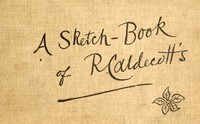
A Sketch-Book of R. Caldecott's
Reproduced by Edmund Evans the Engraver & Printer
& Published by George Routledge & Sons
Dedicated to Everybody-- but copyright reserved.
Randolph Caldecott's A Sketch-Book reproduces a series of preparatory drawings that offer a direct view of the artist's working method. Unlike finished illustrations, these sketches capture moments of observation and experimentation—quick notations of posture, movement, and setting. The volume, engraved by Edmund Evans, preserves the spontaneity of Caldecott's line work, from loose pencil strokes to more resolved studies. The selection spans rural life, equestrian subjects, and character vignettes, each sheet revealing how Caldecott built compositions from isolated details. The absence of a narrative thread or explanatory text places the focus squarely on the visual evidence of the artist's hand.
Caldecott's sketches demonstrate a deliberate economy of line. In many studies, a few swift strokes define a horse's gait or a figure's posture, with minimal shading. The artist often leaves parts of the paper blank, allowing the white space to suggest volume or distance. This restraint is not a sign of incompleteness but a calculated choice to capture essential form. For instance, a rearing horse is rendered with a single curved line for the neck and a series of dashes for the mane, while the rider's arm is implied rather than fully drawn. Such shorthand techniques are typical of preparatory work meant to record an impression quickly.
Horses appear repeatedly throughout the sketchbook, often paired with riders in various states of motion. Caldecott studies the animal from multiple angles: a side view of a trotting horse, a rear view of a mounted figure, and a close-up of a horse's head. The riders are sketched with equal attention to the tilt of a hat or the bend of an elbow. These repeated studies suggest a fascination with equine anatomy and the dynamics of riding. The sketches are not polished equestrian portraits but working notes—the artist testing how to convey speed, balance, and the relationship between human and animal.
Several sketches depict rural scenes: a farmer with a pitchfork, a woman carrying a bundle, a dog trotting beside a cart. These figures are often isolated against minimal backgrounds, emphasizing their gestures and clothing. Caldecott's interest in everyday life is evident in the careful rendering of a smock's folds or the brim of a hat. The sketches lack the sentimental gloss of many Victorian illustrations; instead, they present a matter-of-fact record of rural types. The artist's eye for detail—the way a hand grips a tool or a dog's tail curves—anchors these studies in observed reality rather than idealization.
Readers approaching A Sketch-Book of R. Caldecott's should treat it as a visual document of process rather than a finished portfolio. The absence of captions or dates invites speculation about the sketches' original purpose—were they studies for book illustrations, personal observations, or exercises in draftsmanship? The volume rewards close attention to the artist's choices of line, composition, and subject, offering insight into the preparatory stages behind Caldecott's better-known published work.
There’s something tender about watching an artist hesitate on paper—those first faint lines in Caldecott’s sketches stay with me long after closing the book. It reminded me of how Artists Past and Present; Random Studies holds that same quiet intimacy, not polished arguments but lingering glances at how seeing becomes making. Some books simply leave a warm residue, like an afternoon spent in someone’s studio. Artists Past and Present; Random Studies — Themes and Context settled that way for me.
Create a short personal record of your experience with this book.









