About 41 minutes
Mr. Punch's "Animal Land" — Background and Themes
Architecture
9,364 recorded words. 2 minutes difference from this book's estimate.
View Gutenberg source #47907
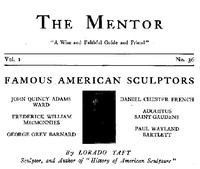
Before opening The Mentor: Famous American Sculptors, Vol. 1, Num. 36, Serial No. 36 — Background and Themes, the edition data offers a quick orientation: 9,784 words, 43 min estimated reading time, and 2 detected text sections.
The text analysis averages about 19.5 words per sentence, while the detected sections provide another way to judge how the source is divided.
Project Gutenberg metadata also associates the work with “Sculpture, American,” connecting these edition facts with the source record’s subject description.
Explore this collection
These alternatives are selected using recorded categories and estimated reading time.
About 41 minutes
Architecture
9,364 recorded words. 2 minutes difference from this book's estimate.
View Gutenberg source #47907About 39 minutes
Architecture
8,888 recorded words. 4 minutes difference from this book's estimate.
View Gutenberg source #75295About 37 minutes
Architecture
8,299 recorded words. 6 minutes difference from this book's estimate.
View Gutenberg source #69978Search stored excerpts and compare books → Choose by your preferences →
Choices use stored catalog measurements. Estimates vary with reading speed. A shared category is a catalog label, not a claim that two books have the same argument or literary quality.
Search reads excerpt text stored with this catalog and links to its associated Gutenberg record. The connection is stored in the site database; this tool does not recheck that every excerpt is word-for-word identical to that external record. Excerpt search does not cover every chapter and does not verify historical publication dates.
Catalog snapshot checked: 2026-09-25. Coverage: 93 public books, 93 available source excerpts.
Calculated from edition completeness, EPUB availability, text structure and catalogue metadata. Not a user rating.
Total of 100 points, scaled to a 2.5-5.0 range. Editions with an empty description or a missing EPUB file are not scored.
Public-domain source text
The source text is kept in the dedicated reader, separate from this catalogue record and its commentary.
Lorado Taft, a practicing sculptor and author of a history of American sculpture, writes this Mentor issue with an insider's attention to craft. He describes the nation's sculptural output as moving from a 'crude parody' of European models to a proud showing at the 1900 Paris Exposition within seventy years. Taft's language is precise: he notes that early sculptors 'held the fort' at home while others worked abroad, and he singles out Saint Gaudens as 'the most skilful' and 'most versatile.' The text is built around brief biographical sketches, but Taft's own voice—judging, comparing, and occasionally quoting the artists—gives the reader a sense of the workshop as much as the gallery.
Taft's word choices map a trajectory of artistic progress. He calls early American sculpture a 'crude parody' of Canova and Thorvaldsen, then later praises Saint Gaudens's 'severe, imposing character' in the Deacon Chapin statue. The shift from dismissive to admiring diction mirrors the historical arc he describes. When discussing Daniel Chester French, Taft uses phrases like 'nature smiled on' and 'conspired to help his development,' personifying fortune. He also reports French's father exclaiming 'Daniel, there is your career!' upon seeing a turnip frog—a moment of dialogue that Taft preserves to show how a career began. These verbal choices reveal Taft's own criteria: he values native development over imitation, and he highlights moments of personal revelation.
Taft includes direct quotations sparingly but to strong effect. When French's father sees the turnip frog, he declares 'Daniel, there is your career!'—a line that Taft uses to mark a turning point. Later, Emerson tells French of his bust, 'The more it resembles me, the worse it looks,' then adds 'That is the face that I shave.' Taft presents this as evidence of the bust's lifelikeness. The dialogue is not decorative; it serves as proof of the sculptor's skill and the sitter's reaction. In the Ward section, Taft quotes the inscription on the Washington pedestal verbatim, grounding the statue in its historical site. These quoted words are the only direct speech in the excerpts, and Taft deploys them to authenticate the artists' relationships and the public's reception.
Taft describes sculptures through contrast and context. He sets Saint Gaudens's Farragut statue against the 'severe, imposing' Deacon Chapin, then contrasts both with the Shaw Memorial and the 'strange, mysteriously beautiful figure' in Rock Creek Cemetery. He does not describe the works in exhaustive detail; instead, he uses adjectives that evoke mood—'stirring,' 'mysteriously beautiful'—and relies on the reader's familiarity or imagination. For French's 'Alma Mater,' he notes only that it is a 'great heroic female figure' seated at Columbia's library. The descriptions are economical, often pairing a statue with its location: the Washington statue on Wall Street, the Minute Man at Concord. Taft's method is to place the work in a physical and emotional landscape, not to catalog its features.
Taft organizes each sculptor's entry as a compressed biography that doubles as a critical assessment. He begins with birth and early influences, then moves to key works and public reception. For French, he notes ancestry (Daniel Webster, John Greenleaf Whittier), a turnip frog, a visit to Ward's studio, and the Minute Man commission—all within a few paragraphs. The structure implies that an artist's life explains his art. Taft also groups sculptors by generation: the pioneers who worked abroad, the 'home' sculptors like Ward, and the French-trained school led by Saint Gaudens. This framework lets him compare without lengthy analysis. The brevity of each sketch (the entire text is under 10,000 words) forces Taft to select only the most telling details, making every fact carry interpretive weight.
Taft's editorial choices—his diction of progress, his use of quoted speech, his contrastive descriptions, and his biographical structure—all serve to present American sculpture as a story of rapid maturation. Readers should attend to how Taft, himself a sculptor, evaluates works not by surface beauty but by technical and expressive power. The issue rewards those who read between the lines of its compact biographies, noticing which details Taft includes and which he omits, and how his own voice shapes the narrative of an art form finding its footing.
Taft’s concern with how artists reveal themselves through their chosen subjects—the quiet, telling decisions—reminds me of a certain affinity for the accidental and uncertain. That same patience for the unfinished thread runs through Greasy luck — Themes and Context, which feels less like a destination and more like a familiar, slightly crooked path we’ve walked before, and will likely walk again.
Answer a few questions and save a private reflection on this device.









