About 294 minutes
The Englishman's House: A Practical Guide for Selecting and Building a House — A Closer Reading
Architecture
67,494 recorded words. 5 minutes difference from this book's estimate.
View Gutenberg source #60759
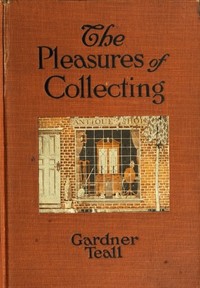
The Pleasures of Collecting — Key Ideas to Explore can be approached with a clearer sense of reading commitment from its source measurements: 68,611 words, 4 hr 59 min estimated reading time, and 13 detected text sections.
The text analysis averages about 23.6 words per sentence, while the detected sections provide another way to judge how the source is divided.
Project Gutenberg metadata also associates the work with “Collectors and collecting,” connecting these edition facts with the source record’s subject description.
Explore this collection
These alternatives are selected using recorded categories and estimated reading time.
About 294 minutes
Architecture
67,494 recorded words. 5 minutes difference from this book's estimate.
View Gutenberg source #60759About 287 minutes
Architecture
65,935 recorded words. 12 minutes difference from this book's estimate.
View Gutenberg source #44393About 274 minutes
Architecture
62,886 recorded words. 25 minutes difference from this book's estimate.
View Gutenberg source #11391Search stored excerpts and compare books → Choose by your preferences →
Choices use stored catalog measurements. Estimates vary with reading speed. A shared category is a catalog label, not a claim that two books have the same argument or literary quality.
Search reads excerpt text stored with this catalog and links to its associated Gutenberg record. The connection is stored in the site database; this tool does not recheck that every excerpt is word-for-word identical to that external record. Excerpt search does not cover every chapter and does not verify historical publication dates.
Catalog snapshot checked: 2026-09-25. Coverage: 93 public books, 93 available source excerpts.
Calculated from edition completeness, EPUB availability, text structure and catalogue metadata. Not a user rating.
Total of 100 points, scaled to a 2.5-5.0 range. Editions with an empty description or a missing EPUB file are not scored.
Public-domain source text
The source text is kept in the dedicated reader, separate from this catalogue record and its commentary.
Gardner Teall opens The Pleasures of Collecting with a spirited defense of the collector's passion, describing the true collector as one who "does not apologize for his hobbies; he exalts their virtues." This declaration sets the tone for a work that is part practical handbook, part philosophical meditation on the art of collecting. Teall addresses the collector's need for discretion when surrounded by unsympathetic associates, and he quotes Charles Lamb's rhapsodic question, "Antiquity! thou wondrous charm, what art thou? that, being nothing, art everything?" The book's subtitle promises "sundry delectable excursions in the realm of antiques and curios, American, European, and Oriental," and the excerpts reveal a wide-ranging interest in furniture, porcelain, and decorative arts.
Teall devotes considerable attention to the psychology of collecting, portraying the true collector as someone who must navigate a world of "unequipped infidels" and "supercilious" skeptics. He advises maintaining "reticence in order that he may enjoy a normal place in the community," a pragmatic strategy for preserving one's peace of mind. The author's own voice is that of an enthusiast who nonetheless recognizes the social pressures that can accompany a consuming hobby. He warns against the "gushing of the undiscriminating susceptible" and the "curt depreciation of the supercilious," suggesting that the collector's joy is best protected by selective disclosure. This emphasis on the collector's inner life—the tension between private passion and public persona—gives the book a reflective dimension beyond mere cataloging.
In his discussion of furniture, Teall traces the evolution of the console table from a purely ornamental bracket-supported shelf to a functional piece that eventually inspired the sideboard. He notes that Sheraton called consoles "portables" and deemed them "indispensable in the drawing-room." Teall describes early consoles with "bold florid and exaggerated types in soft wood, carved and gilded," and he observes that during the Empire period the eagle became a popular support motif, citing examples in the Duke of Beaufort's collection and the White House. He also highlights the influence of Robert Adam, who "made exhaustive researches in France and Italy" and whose classical taste shaped late eighteenth-century furniture. Teall's practical advice—placing consoles under mirrors in drawing-rooms or in hallways—reflects his dual interest in historical context and modern application.
Teall acknowledges that Sèvres porcelain, though widely known by name, is less understood by collectors than English or German wares. He notes that "over fifty marks for Sèvres, nearly two hundred and fifty marks of painters, decorators, and gilders" are known, along with some thirty-five principal fabrication marks from 1753 onward. This complexity, he suggests, requires "some study to master it." The author does not provide a complete guide to Sèvres marks in the excerpt, but his emphasis on the difficulty of authentication underscores a recurring theme: collecting is a learned skill that demands patience and attention to detail. The contrast between the casual admirer and the serious student of porcelain mirrors the broader distinction Teall draws between the true collector and the merely curious.
Teall's book is best approached as a series of essays rather than a systematic encyclopedia. Readers interested in a specific category—such as American furniture or French porcelain—will find focused chapters, but the work's real value lies in its portrayal of the collector's mindset. The author's voice, at once defensive and celebratory, invites the reader to share in the "solaces" of a passion that requires both knowledge and discretion. For those new to antiques, the book offers a window into early twentieth-century collecting culture; for experienced collectors, it provides a historical perspective on enduring questions of taste and authenticity.
Reading Teall’s careful eye on old porcelain, I remembered my grandmother’s chipped teacup, and how she’d trace its gold rim as if reading a letter. That same hush came over me with The Arts and Crafts of Ancient Egypt — Story, Setting & Ideas, where even broken shards felt like a kind of quiet language waiting for someone to listen.
Save your reaction, strongest insight, and memorable passage.









