About 452 minutes
An Autobiography — A Closer Reading
Architecture
103,775 recorded words. 8 minutes difference from this book's estimate.
View Gutenberg source #41638
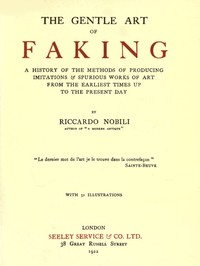
For The Gentle Art of Faking A history of the methods of producing imitations & spurious works of art from the earliest times up to the present day — Key Ideas to Explore, the stored edition analysis reports 105,681 words, 7 hr 40 min estimated reading time, and 30 detected text sections.
The text analysis averages about 29.0 words per sentence, while the detected sections provide another way to judge how the source is divided.
Project Gutenberg metadata also associates the work with “Collectors and collecting,” connecting these edition facts with the source record’s subject description.
Explore this collection
These alternatives are selected using recorded categories and estimated reading time.
About 452 minutes
Architecture
103,775 recorded words. 8 minutes difference from this book's estimate.
View Gutenberg source #41638About 428 minutes
Architecture
98,231 recorded words. 32 minutes difference from this book's estimate.
View Gutenberg source #28420About 499 minutes
Architecture
114,723 recorded words. 39 minutes difference from this book's estimate.
View Gutenberg source #26378Search stored excerpts and compare books → Choose by your preferences →
Choices use stored catalog measurements. Estimates vary with reading speed. A shared category is a catalog label, not a claim that two books have the same argument or literary quality.
Search reads excerpt text stored with this catalog and links to its associated Gutenberg record. The connection is stored in the site database; this tool does not recheck that every excerpt is word-for-word identical to that external record. Excerpt search does not cover every chapter and does not verify historical publication dates.
Catalog snapshot checked: 2026-09-25. Coverage: 93 public books, 93 available source excerpts.
Calculated from edition completeness, EPUB availability, text structure and catalogue metadata. Not a user rating.
Total of 100 points, scaled to a 2.5-5.0 range. Editions with an empty description or a missing EPUB file are not scored.
Public-domain source text
The source text is kept in the dedicated reader, separate from this catalogue record and its commentary.
Riccardo Nobili opens The Gentle Art of Faking by framing art forgery as a comedy with three principal roles: the Collector, the Dealer, and the Faker. This structural triad recurs throughout the book, each character reappearing in varied contexts—from Renaissance workshops to modern customs offices. Nobili’s narrative moves fluidly between scenes: a Roman studio where a painting is temporarily degraded to evade export laws, a Parisian gallery where a bust is passed off as a Renaissance original, and the border checkpoint where psychological games unfold. The book’s recurring image is the reversible alteration—a coat of glue applied to a masterpiece, then washed away once the frontier is crossed. This motif of temporary disguise mirrors the larger theme of art’s identity as something that can be layered, stripped, and reassigned.
Nobili explicitly organizes his history around three figures: the Collector, the Dealer, and the Faker. This is not merely a cast list but a structural principle. Each chapter returns to this triad, showing how their interactions generate the market for fakes. The Collector’s desire, the Dealer’s cunning, and the Faker’s skill form a closed loop. Nobili illustrates this with the case of the Bastianini Benivieni bust—a direct cast from an original, passed off as a portrait of a poet. The bust’s journey from a Florentine workshop to the Louvre exemplifies how the triad operates across borders. The structure allows Nobili to shift between historical periods without losing coherence: the same roles appear in ancient Rome, Renaissance Italy, and modern Paris.
A central image in the book is the temporary alteration of a work of art. Nobili describes how a valuable painting is deliberately made to look like a daub: a coat of glue is applied, then offensive disproportions are painted over it. Once the painting has crossed the frontier, the additions are washed away, restoring the original. This process is the reverse of restoration—instead of improving, it degrades temporarily. The image recurs in discussions of smuggling, where objects are disguised as worthless copies. Nobili emphasizes the psychological dimension: the faker studies the inspector’s “faulty idiosyncrasies” to predict what will pass. The reversible transformation becomes a metaphor for the instability of artistic identity in the market.
Nobili’s narrative moves rapidly between settings, often within a single paragraph. A typical sequence begins in a Roman studio where a faker applies a temporary disguise, then shifts to the Export Office where inspectors examine the work, then to the frontier where the painting is smuggled, and finally to a foreign gallery where it is restored. This movement mirrors the journey of the object itself. Nobili uses these scene shifts to highlight the contrast between the intimate craft of the studio and the bureaucratic theater of the customs house. The border becomes a stage where the faker’s psychological acumen is tested. The Italian adage Fatta la legge trovato l’inganno (make a law and the means of evasion are found) recurs as a refrain, linking each scene to a cycle of regulation and evasion.
Nobili devotes considerable attention to the legal frameworks that attempt to control art export, particularly in Italy. He traces a lineage from Medici punishments in the sixteenth century to Papal laws and the “iron laws” of the Kingdom of the Two Sicilies. Modern laws, he notes, are preventive: owners must submit works to inspectors, who grant or deny export permits. Yet the faker’s art has become a “science” that exploits the psychology of officials. Nobili recounts skirmishes where paintings are transformed into daubs, or where reproductions are passed as originals. The law, he suggests, does not stop deception but refines it. This section grounds the book’s broader themes in concrete legal history, showing how structure and scene are shaped by regulation.
Readers should attend to Nobili’s use of the triad—Collector, Dealer, Faker—as a lens through which each anecdote is filtered. The book’s strength lies not in comprehensive coverage but in the vivid, almost theatrical scenes that illustrate the mechanics of forgery. Pay particular attention to the recurring motif of reversible alteration, which ties together the technical, legal, and psychological dimensions of the subject.
There is such a quiet ache in reading Nobili’s old book—how the faker’s cleverest work was almost tender, a devotion to mimicry that fooled even the faker. It makes me think of simpler hands, sketching what they loved without pretense, like the gentle studies in A Sketch-Book of R. Caldecott's — A Reader’s Guide. We keep returning to what was made honestly, even when the world has moved on.
Build a private reading journal entry for this title.









