About 186 minutes
Sculpture in Spain — A Reader’s Guide
Architecture
42,657 recorded words. 4 minutes difference from this book's estimate.
View Gutenberg source #60898
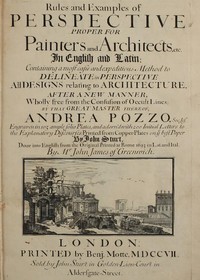
The catalog record for Rules and Examples of Perspective proper for Painters and Architects, etc. In English and Latin: Containing a most easie and expeditious method to delineate in — Background and Themes provides practical reading context through 43,544 words, 3 hr 10 min estimated reading time, and 9 detected text sections.
The text analysis averages about 21.4 words per sentence, while the detected sections provide another way to judge how the source is divided.
Project Gutenberg metadata also associates the work with “Perspective -- Early works to 1800,” connecting these edition facts with the source record’s subject description.
Explore this collection
These alternatives are selected using recorded categories and estimated reading time.
About 186 minutes
Architecture
42,657 recorded words. 4 minutes difference from this book's estimate.
View Gutenberg source #60898About 194 minutes
Architecture
44,489 recorded words. 4 minutes difference from this book's estimate.
View Gutenberg source #67591About 173 minutes
Architecture
39,587 recorded words. 17 minutes difference from this book's estimate.
View Gutenberg source #52830Search stored excerpts and compare books → Choose by your preferences →
Choices use stored catalog measurements. Estimates vary with reading speed. A shared category is a catalog label, not a claim that two books have the same argument or literary quality.
Search reads excerpt text stored with this catalog and links to its associated Gutenberg record. The connection is stored in the site database; this tool does not recheck that every excerpt is word-for-word identical to that external record. Excerpt search does not cover every chapter and does not verify historical publication dates.
Catalog snapshot checked: 2026-09-25. Coverage: 93 public books, 93 available source excerpts.
Calculated from edition completeness, EPUB availability, text structure and catalogue metadata. Not a user rating.
Total of 100 points, scaled to a 2.5-5.0 range. Editions with an empty description or a missing EPUB file are not scored.
Public-domain source text
The source text is kept in the dedicated reader, separate from this catalogue record and its commentary.
Andrea Pozzo's Rules and Examples of Perspective (1707) opens with a dedication to Queen Anne that situates the art of perspective alongside painting and architecture, citing contemporary projects such as St. Paul's and Greenwich Hospital. The bilingual Latin-English text immediately establishes a dual readership: the learned amateur and the practicing artisan. Pozzo's method promises to free the draftsman from the 'Confusion of Occult Lines' by offering a systematic approach grounded in geometric plans and elevations.
The treatise repeatedly demonstrates how a geometric plan (vestigium geometricum) is transformed into a perspective view. Pozzo introduces the concept of a 'net-work'—a grid of squares drawn on the pavement—to transfer outlines from paper designs to the actual painting surface. He warns that squares must be 'exactly divided, and at right Angles,' and provides a compass method for constructing a perpendicular. The net-work can be reused across multiple designs if the squares are proportionally adjusted, saving labor. This practical emphasis on repeatable steps reveals Pozzo's background as a Jesuit brother accustomed to teaching through clear, replicable procedures.
Pozzo devotes special attention to putting circles into perspective, a notoriously difficult task. In Figure 65, he states bluntly that those who have not 'diligently apply'd themselves' to this skill will 'in vain attempt' circular plans. To avoid confusion, he recommends first marking the 'occult lines' of principal members in the plan, then transferring them to the elevation, and gradually adding the rest. He acknowledges the 'summam arduitatem' (extreme difficulty) of these descriptions and hints at a separate rule reserved for another work. This candid admission of complexity contrasts with the confident tone of the opening pages.
One of the most vivid passages describes a temporary structure Pozzo designed for the 'Solemnity of the Forty Hours.' He painted it on a machine and exhibited it 'with an universal Satisfaction.' The design, based on a square plan and elevation, could serve as a model for a church high altar. Angels with clouds occupy the upper hemisphere, while groups of figures fill the lower part. This example bridges the gap between theoretical rules and festive, ephemeral architecture, showing how perspective could create illusionistic effects for religious ceremonies. The description is brief, but it hints at the theatrical applications of Pozzo's method.
The book's facing-page layout places Latin on the left and English on the right, with the engraved figures integrated into the text. The translator, John James, notes that figures have been moved from their original positions to sit beside the relevant passages. The English text often expands slightly on the Latin, clarifying steps or adding remarks such as 'the ready way of making a right Angle is thus.' This bilingual format suggests the work was intended for an international audience of architects and painters, as well as for English readers who might rely on the translation while consulting the original plates. The inclusion of 105 folio plates and 200 initial letters underscores the book's ambition as a comprehensive manual.
Readers approaching Pozzo's treatise should attend to the interplay between text and image: the plates are not mere illustrations but integral to the instruction. The bilingual presentation rewards comparison, as the Latin often condenses what the English expands. Pozzo's method, though rooted in geometry, repeatedly acknowledges the practical difficulties of execution, making this a manual for the workshop as much as the study.
There’s something peaceful about old manuals, the way Rules and Examples of Perspective turns complicated geometry into patient, step-by-step drawings you can almost hear someone thinking through. It stayed with me because it felt like watching a mind at work, not just technique. That same quiet awe came back with Cruikshank's Water Colours — Key Ideas to Explore, as if color held its own careful secrets, waiting to be noticed slowly.
Your answers remain private and are stored only in this browser.









