
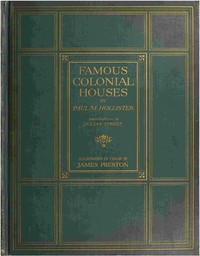
Famous Colonial Houses — Inside the Classic

(0 User reviews)   1073
In Category - Architecture
Hollister, Paul M. (Paul Merrick), 1890-1970, Street, Julian, 1879-1947 [Author of introduction, etc.], Preston, James M., 1873-1962 [Illustrator] Project Gutenberg 2022 Not confirmed
Architecture, Colonial; Architecture, Domestic -- United States; Historic buildings -- United States; Dwellings -- United States Readers of public-domain and historical texts
Project Gutenberg digital edition en

Edition facts

Words 44,489
Reading time 194 min
Text sections 31

Before opening Famous Colonial Houses — Inside the Classic, the edition data offers a quick orientation: 44,489 words, 3 hr 14 min estimated reading time, and 31 detected text sections.

The text analysis averages about 24.6 words per sentence, while the detected sections provide another way to judge how the source is divided.

Project Gutenberg metadata also associates the work with “Architecture, Colonial,” connecting these edition facts with the source record’s subject description.

Explore this collection

Compare your next read

These alternatives are selected using recorded categories and estimated reading time.

Search stored excerpts and compare books → Choose by your preferences →

How these choices and excerpts are prepared

Choices use stored catalog measurements. Estimates vary with reading speed. A shared category is a catalog label, not a claim that two books have the same argument or literary quality.

Search reads excerpt text stored with this catalog and links to its associated Gutenberg record. The connection is stored in the site database; this tool does not recheck that every excerpt is word-for-word identical to that external record. Excerpt search does not cover every chapter and does not verify historical publication dates.

Catalog snapshot checked: 2026-09-25. Coverage: 93 public books, 93 available source excerpts.

Paul M. Hollister's 1921 survey of notable colonial American houses, combining architectural description with anecdotal history. The book's catalog subjects emphasize domestic architecture and historic buildings, but the excerpts reveal a stronger focus on eccentric inhabitants and local lore than on structural analysis.
Share
Editorial Edition Score 4.9/5

Calculated from edition completeness, EPUB availability, text structure and catalogue metadata. Not a user rating.

How this score is calculated
  • Description quality20 pts
  • Title & short description10 pts
  • Source metadata20 pts
  • Text length15 pts
  • Chapters / structure15 pts
  • EPUB file integrity20 pts

Total of 100 points, scaled to a 2.5-5.0 range. Editions with an empty description or a missing EPUB file are not scored.

Edition quality

Public-domain source text

Read the source text

The source text is kept in the dedicated reader, separate from this catalogue record and its commentary.

Paul M. Hollister's Famous Colonial Houses (1921) opens not with a blueprint but with a quip: Rochambeau's aide remarked that Jefferson 'is the first American who has consulted the fine arts to know how he should shelter himself from the weather.' This sets the tone for a book that treats houses as stages for personality. The catalog lists it under 'Architecture, Colonial' and 'Architecture, Domestic,' but the excerpts show Hollister far more interested in the people who lived in these houses than in their floor plans or stylistic details.

Anecdote Over Architecture

Despite its title, the book devotes considerable space to biographical sketches and local legends. The chapter on the Timothy Dexter Mansion, for example, spends far more words on Dexter's eccentricities—his self-appointed lordship, his poet laureate Jonathan Plummer, and his garish renovations—than on the house's colonial architecture. Hollister describes Dexter's additions as making the house 'look like a Christmas tree gone mad,' a phrase that captures the author's preference for colorful narrative over measured description. The catalog subject 'Architecture, Colonial' thus proves misleading: the book is less a systematic study of colonial building styles than a collection of character-driven vignettes.

The Author's Confessed Method

In his foreword, Hollister admits to 'a snapping-up of ill-considered trifles where I found them,' and acknowledges that some information came from owners who 'have even read this manuscript.' This candid disclosure reveals his method: he prioritizes engaging stories over scholarly rigor. The book lacks a bibliography, as he freely states. Readers expecting a formal architectural history will find instead a personal, anecdotal tour. The catalog's secondary topic 'cooking-home' hints at domestic life, but the excerpts show Hollister more drawn to the bizarre than the everyday—Dexter's poet laureate, for instance, or the 'iron-dog-and-Diana tendency' on wealthy lawns.

Illustrations and Their Role

James M. Preston's illustrations accompany each chapter, and the transcriber's note advises that larger versions may be viewed by right-clicking. The illustrations are 'especially engraved and printed by the Beck Engraving Company,' suggesting a high-quality production. However, the excerpts do not describe the illustrations' content or how they relate to the text. Given Hollister's anecdotal focus, the images likely depict the houses' exteriors or interiors, but without seeing them, the reader must infer their contribution. The book's structure—31 text sections covering 14 houses plus an appendix—implies a visual complement that the text alone does not fully document.

Readers approaching Famous Colonial Houses should set aside expectations of a dry architectural catalog. Hollister's work rewards those who enjoy historical gossip and character sketches set against colonial backdrops. The book's value lies not in its architectural precision but in its preservation of early 20th-century attitudes toward colonial heritage, filtered through a narrator who freely admits his sources are 'gifts, some purchases, some thefts.'

Leafing through Hollister’s old survey, I found myself lingering less on the wainscoting and more on the people who once rattled around those quiet rooms. Their odd, stubborn lives felt so vivid that I set the book down, thinking of another volume altogether, one that traces the same restless character across a broader canvas: Art in America: A Critical and Historial Sketch — Key Ideas to Explore. A shared, unspoken thread, really.

There are no reviews for this eBook.

0
0 out of 5 (0 User reviews )

Add a Review

Your Rating *
There are no comments for this eBook.

Reader reflection

How did this book work for you?

Your answers remain private and are stored only in this browser.

Your progress 0 / 10
1

Where are you in your reading?

2

Was reading this book enjoyable?

3

Would you pass this book on to a friend?

4

How demanding did the text feel?

Related eBooks









