
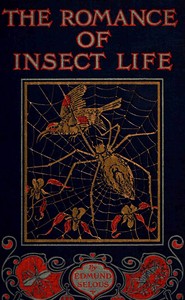
The romance of insect life : Interesting descriptions of the strange and…
Forget everything you think you know about old natural history books being stuffy. Edmund Selous's The Romance of Insect Life is a delightful surprise. It’s a series of observational essays where Selous acts as our patient, curious guide to the miniature world of insects. He doesn't give us a systematic catalog. Instead, he takes us by the hand and says, "Look at this!"
The Story
There isn't a single plot, but there is a clear journey. The "story" is Selous's own adventure of discovery in his local environment. He chronicles the life-and-death struggles of beetles, the complex social world of ants and bees, the hunting techniques of wasps, and the metamorphosis of butterflies. He presents each insect not as a specimen, but as a character in its own right, with drives, challenges, and a will to live. We see a beetle fighting to right itself, ants engaging in what looks like cattle farming with aphids, and the eerie, precise work of parasitic wasps. It's a panoramic view of a world operating on rules that feel both alien and deeply familiar.
Why You Should Read It
What makes this book special is Selous's voice. His writing comes from a place of pure wonder. He’s not a detached scientist; he’s a guy lying on his stomach in the grass, completely absorbed. This passion is contagious. He finds heroism, tragedy, and ingenious engineering in the everyday actions of bugs. Reading it slows you down and changes your perspective. You start to see a walk in the garden not as a simple stroll, but as a trip through a bustling metropolis of tiny creatures. It’s a masterclass in paying attention. Sure, some of the scientific understanding is dated (it was published in 1909), but that almost adds to the charm. It’s a snapshot of a moment when nature writing was becoming less about classification and more about feeling a connection to the natural world.
Final Verdict
This book is perfect for anyone with a curious mind and a little patience. It’s for the gardener who wonders about the life in the soil, the hiker who notices intricate webs, or the reader who enjoys classic, thoughtful prose. If you liked the quiet observation in books like Pilgrim at Tinker Creek or the gentle wonder of Gerald Durrell’s work, you’ll find a kindred spirit in Edmund Selous. It’s not a fast-paced thriller; it’s a calming, mind-expanding read that reminds you the world is far stranger and more wonderful than we usually notice.
You are viewing a work that belongs to the global public domain. Enjoy reading and sharing without restrictions.
Thomas Perez
7 months agoInitially, I was looking for a specific answer, but the way the author breaks down the core concepts is remarkably clear. Truly a masterpiece of digital educational material.
Mary Thomas
5 months agoThe methodology used in this work is academically sound.
Susan Martin
6 months agoBefore I started my latest project, I read this and it manages to maintain a consistent flow even when discussing difficult topics. It’s a comprehensive resource that doesn't feel bloated.
Kimberly Brown
2 years agoAs a professional in this niche, the author’s unique perspective adds a fresh layer to the discussion. If you want to master this topic, start right here.

Richard Rodriguez
3 months agoI stumbled upon this title during my weekend research and the argument presented in the middle section is particularly compelling. Top-tier content that deserves more recognition.