
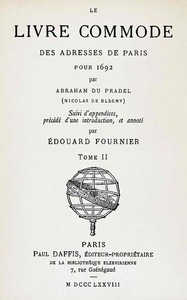
Le livre commode des adresses de Paris pour 1692, tome 2/2 by Monsieur de Blégny
Let's be clear from the start: this isn't a book you 'read' in the normal way. Le livre commode des adresses de Paris pour 1692 is a primary source, a raw artifact. Monsieur de Blégny, a doctor and entrepreneur, compiled it as a practical resource for the well-to-do visitor or new resident of Paris. He organized it by trade and service, promising convenience.
The Story
There is no traditional plot, but there is a dramatic real-life story behind the pages. Blégny published his directory, and almost immediately, powerful people were furious. His listings were too accurate. He didn't just include reputable merchants; he included the addresses of fortune-tellers, back-alley moneylenders, and masters of fencing (for arranging duels). He pointed readers to experts who could fix 'delicate' legal problems. In doing so, he pulled back the curtain on the city's informal—and often illegal—networks. The authorities saw it as a threat to public order and morality. Blégny was sued by the very professional guilds he listed and was eventually sent to prison. The 'story' is the conflict between his goal of public information and the establishment's need for secrecy and control.
Why You Should Read It
Reading this is like getting a master key to 17th-century Parisian life. The dry lists come alive when you realize what they represent. Look up 'apothecary' and you might find someone selling love potions. Look up 'lawyer' and find one known for getting people out of jail. It's a social network diagram made centuries before social media. You see the city not as kings and architects built it, but as its inhabitants actually lived it—with all its messy, human needs for gossip, quick fixes, and hidden services. Blégny’s fate adds a layer of real stakes, reminding us that information has always been powerful and dangerous.
Final Verdict
This is not for everyone. If you want a flowing historical narrative, look elsewhere. But if you're the kind of person who loves detective work, old maps, or digging through archives, this is a treasure. It's perfect for history buffs who want to move beyond textbooks, for writers seeking authentic period detail, or for any curious soul who wonders what really happened on the streets of a famous city. Think of it as the most fascinating user manual ever written, one that landed its author in jail.
This masterpiece is free from copyright limitations. Distribute this work to help spread literacy.
Michael Lopez
7 months agoI found the author's tone to be very professional yet accessible, the insights into future trends are particularly thought-provoking. An excellent example of how quality digital books should be formatted.
Elizabeth Thomas
8 months agoThe clarity of the concluding remarks is very professional.
David Miller
9 months agoI found the author's tone to be very professional yet accessible, the breakdown of complex theories into digestible segments is masterfully done. A refreshing and intellectually stimulating read.
Emily Martin
2 years agoThe clarity of the introduction set high expectations, and the nuanced approach to the central theme was better than I expected. A rare gem in a sea of mediocre content.





John Martin
4 months agoI started reading this with a critical mind, the formatting on mobile devices is surprisingly crisp and clear. Thanks for making such a high-quality version available.