About 670 minutes
History of Ancient Art — Context and Discussion
Architecture
153,874 recorded words. 110 minutes difference from this book's estimate.
View Gutenberg source #42082
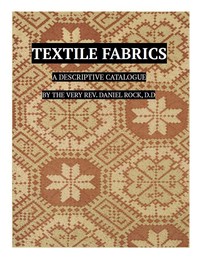
This digital edition of Textile Fabrics A Descriptive Catalogue of the Collection of Church-vestments, Dresses, Silk Stuffs, Needlework and Tapestries, forming that Section of the Museum — Reading Notes is described by source-level measurements including 179,392 words, 13 hr estimated reading time, and 49 detected text sections.
The text analysis averages about 19.3 words per sentence, while the detected sections provide another way to judge how the source is divided.
Project Gutenberg metadata also associates the work with “Textile fabrics,” connecting these edition facts with the source record’s subject description.
Explore this collection
These alternatives are selected using recorded categories and estimated reading time.
About 670 minutes
Architecture
153,874 recorded words. 110 minutes difference from this book's estimate.
View Gutenberg source #42082About 636 minutes
Architecture
146,108 recorded words. 144 minutes difference from this book's estimate.
View Gutenberg source #69581About 594 minutes
Architecture
136,576 recorded words. 186 minutes difference from this book's estimate.
View Gutenberg source #73426Search stored excerpts and compare books → Choose by your preferences →
Choices use stored catalog measurements. Estimates vary with reading speed. A shared category is a catalog label, not a claim that two books have the same argument or literary quality.
Search reads excerpt text stored with this catalog and links to its associated Gutenberg record. The connection is stored in the site database; this tool does not recheck that every excerpt is word-for-word identical to that external record. Excerpt search does not cover every chapter and does not verify historical publication dates.
Catalog snapshot checked: 2026-09-25. Coverage: 93 public books, 93 available source excerpts.
Calculated from edition completeness, EPUB availability, text structure and catalogue metadata. Not a user rating.
Total of 100 points, scaled to a 2.5-5.0 range. Editions with an empty description or a missing EPUB file are not scored.
Public-domain source text
The source text is kept in the dedicated reader, separate from this catalogue record and its commentary.
Daniel Rock’s catalogue of textile fabrics at the South Kensington Museum is a work of meticulous enumeration. Each entry, such as that for a Flemish cope hood embroidered with the Adoration of the Magi, is described with exact dimensions, materials, and century. Rock’s prose shifts between terse cataloguing—‘ground, green; design, conventional flowers’—and brief interpretive remarks, as when he notes that a gold ground ‘is, so to say, a fraud’ because the gilding was applied after weaving. This dual register gives the text a distinctive rhythm: the reader moves from dry specification to sudden, sharp evaluation.
Rock’s narrative voice operates at two distinct paces. The first is the steady, almost mechanical listing of attributes: ‘Worsted Work; ground, green; design, conventional flowers in yellow, with, at one end, a border of foliated boughs.’ Here the language is stripped of ornament, focused on colour, material, and measurement. The second pace emerges when Rock permits himself a judgment or a historical aside. For instance, he describes a piece of applied embroidery as ‘Tame in its design, and easy in its execution’—a terse verdict that breaks the neutral tone. Similarly, he notes that a raised velvet, ‘though now so torn and stitched together, is of a very fine pile.’ These moments of evaluation are rare but striking, and they create a subtle tension between the catalogue’s documentary function and the author’s personal eye.
The catalogue’s structure is driven by the logic of the collection: objects are grouped by type (copes, altar-cloths, needlework pieces) and ordered numerically. Within each entry, Rock follows a consistent pattern: a bold-faced heading with the object’s number and brief title, then a paragraph of description, followed by a line of dimensions. This repetition builds a rhythm that is almost hypnotic. Yet the uniformity is occasionally broken by longer passages, such as the comparison between a romance depicted on a piece of needlework and the legend of Sir Guy of Warwick. These digressions are rare, but they hint at a broader cultural narrative that the catalogue otherwise suppresses. The reader must navigate between the monotony of list and the surprise of narrative.
Throughout the catalogue, Rock returns to certain material details that reveal his preoccupations. Gold thread appears frequently, and he is careful to distinguish between genuine gold wrapped around silk and ‘fraudulent’ gilding applied after weaving. He notes the use of ‘applied pieces of white silk’ for faces in embroidery, with features ‘brought out by the needle in coloured silks.’ The symbolic lamb and flag appear on a German altar-cloth, and Rock observes that the same hand likely worked a stole with a similar style. These recurring observations—on technique, on authenticity, on the trace of the maker—give the catalogue a thematic coherence beyond its taxonomic surface. They suggest that Rock is not merely describing objects but reading them for evidence of craft and history.
Readers approaching this catalogue should attend to the shifts in Rock’s prose: the moments when the enumerator becomes a critic, and the list becomes a story. The work rewards those who read slowly, noticing how a single adjective—‘fraud,’ ‘tame,’ ‘fine’—can alter the tone of an entire entry. The catalogue is not a neutral inventory; it is a record of one scholar’s encounter with a collection, and its voice is as much a part of the history as the textiles themselves.
Flicking through this catalogue, I remembered my grandmother’s sewing box, where faded silks and gold threads waited for mending work never finished. The precise names for weaves felt almost like a secret language. Reading Lectures on Art, Delivered Before the University of Oxford in Hilary Term, 1870 — Text and Context later gave me that same quiet ache — a sense that beauty carries memory, even when the hands that made it are gone.
Save your reaction, strongest insight, and memorable passage.









