
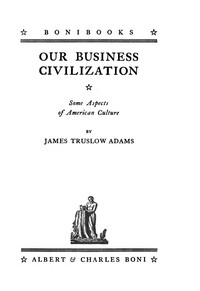
Our business civilization : some aspects of American culture by Adams
Published in 1929, right before the stock market crash, James Truslow Adams's Our Business Civilization is a series of essays that acts like an X-ray of the American soul. Adams, a Pulitzer Prize-winning historian, steps back from the roaring success of the era to ask some uncomfortable questions about its cost.
The Story
There isn't a traditional plot with characters. Instead, Adams lays out his argument like a detective building a case. He examines how the mindset of the factory and the boardroom—what he calls the 'business mind'—has spread far beyond the office. He shows how it values standardization over individuality, speed over craftsmanship, and financial profit over artistic or intellectual achievement. He walks you through examples in education, where learning becomes job training; in the arts, where popularity trumps depth; and in daily life, where leisure is seen as wasted time. The 'story' is the quiet takeover of one set of values by another, and the potential emptiness left behind.
Why You Should Read It
You should read this because it holds up a mirror that still reflects our world with startling clarity. When Adams complains about the pressure to always be 'productive,' the glorification of busyness, or how art gets judged by its commercial potential, you'll catch yourself nodding. It's not an anti-capitalist rant; it's a plea for balance. He argues that a great civilization needs more than just economic power—it needs space for philosophy, beauty, and pure, unprofitable curiosity. Reading this in the age of side hustles and optimization culture feels incredibly validating. It reminds you that the anxiety of measuring your worth by your output isn't a new personal failing, but a long-standing cultural pressure.
Final Verdict
This book is perfect for anyone feeling worn down by the grind, for history lovers who enjoy seeing the roots of modern problems, and for readers who like smart, opinionated non-fiction that makes you think. It's not a difficult read, but it's a deeply thoughtful one. If you've ever wondered why we work the way we do, or questioned if there's more to life than the bottom line, Adams's nearly 100-year-old critique offers a surprisingly fresh and powerful perspective. It's a short, sharp reminder that some debates about who we are and what we value are timeless.
No rights are reserved for this publication. It is available for public use and education.
Joseph Garcia
6 months agoAs a professional in this niche, the author clearly has a deep mastery of the subject matter. Finally, a source that prioritizes accuracy over hype.
James Davis
7 months agoThis is now a staple reference in my professional collection.
Charles Rodriguez
4 months agoIt’s rare to find such a well-structured narrative nowadays, the level of detail in the second half of the book is truly impressive. This should be on the reading list of every serious professional.
Logan Hill
2 years agoAfter finishing this book, the character development leaves a lasting impact. One of the best books I've read this year.



Patricia White
7 months agoExceptional clarity on a very complex subject.