About 101 minutes
Douris and the Painters of Greek Vases — A Closer Reading
Architecture
23,048 recorded words. 11 minutes difference from this book's estimate.
View Gutenberg source #61034
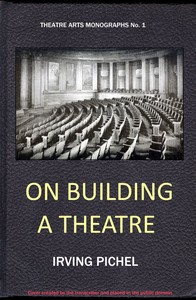
Before opening On building a theatre Stage construction and equipment for small theatres, schools and community — A Closer Reading, the edition data offers a quick orientation: 25,732 words, 1 hr 52 min estimated reading time, and 12 detected text sections.
The text analysis averages about 22.5 words per sentence, while the detected sections provide another way to judge how the source is divided.
Project Gutenberg metadata also associates the work with “Theater architecture,” connecting these edition facts with the source record’s subject description.
Explore this collection
These alternatives are selected using recorded categories and estimated reading time.
About 101 minutes
Architecture
23,048 recorded words. 11 minutes difference from this book's estimate.
View Gutenberg source #61034About 124 minutes
Architecture
28,466 recorded words. 12 minutes difference from this book's estimate.
View Gutenberg source #18371About 100 minutes
Architecture
22,793 recorded words. 12 minutes difference from this book's estimate.
View Gutenberg source #48809Search stored excerpts and compare books → Choose by your preferences →
Choices use stored catalog measurements. Estimates vary with reading speed. A shared category is a catalog label, not a claim that two books have the same argument or literary quality.
Search reads excerpt text stored with this catalog and links to its associated Gutenberg record. The connection is stored in the site database; this tool does not recheck that every excerpt is word-for-word identical to that external record. Excerpt search does not cover every chapter and does not verify historical publication dates.
Catalog snapshot checked: 2026-09-25. Coverage: 93 public books, 93 available source excerpts.
Calculated from edition completeness, EPUB availability, text structure and catalogue metadata. Not a user rating.
Total of 100 points, scaled to a 2.5-5.0 range. Editions with an empty description or a missing EPUB file are not scored.
Public-domain source text
The source text is kept in the dedicated reader, separate from this catalogue record and its commentary.
Irving Pichel opens On Building a Theatre with a blunt observation: architectural ineptitudes are more likely to be perpetuated than those in any other art because buildings, once erected, are inescapable. Unlike a bad painting or unpublished music, a poorly designed theatre may stand for decades, its flaws gradually accepted by daily users. This practical manual, published in 1920 as the first of the Theatre Arts Monographs, addresses the specific needs of small theatres, schools, and community buildings—venues where budgets are tight and expertise scarce. Pichel draws on historical examples from the Teatro Farnese to the Munich Art Theatre, but his focus is squarely on the stage itself: its plan, equipment, lighting, and machinery.
Pichel begins by tracing the architectural tradition of the auditorium, noting how the shape and arrangement of seating have been inherited from Greek, Roman, and Renaissance models. He points to the Teatro Olympico at Vicenza and the Berlin Volksbühne as examples of how sightlines and acoustics were historically prioritized. Yet he warns against blind imitation: a small community theatre cannot simply shrink a grand opera house. The tension between tradition and practicality is a recurring theme. Pichel argues that the auditorium must serve the play, not the architect’s ego, and that even a modest space can be effective if the relationship between stage and seats is carefully considered.
The most detailed technical passage concerns the grid-iron, a slatted platform of steel or iron joists built below the stage roof. Pichel specifies that at least twenty-five sets of lines should be provided, each operated by hemp rope of half-inch minimum diameter. He describes the arrangement of blocks and sheaves, the distinction between short, center, and long lines, and the critical importance of periodic rope inspection to prevent accidents. Counterweights in the form of sandbags are recommended for heavy scenery. Pichel also compares the fly-gallery and floor-level pin-rail, noting that the latter saves a stage-hand but clutters the floor. His advice is concrete: blocks should ride the joists, not be screwed underneath, as screws have been known to tear loose.
Throughout the manual, Pichel balances ideal specifications against the realities of small budgets. He acknowledges that a forty-foot stage opening may require four lines per set, but smaller stages can manage with three. He discusses the trade-off between hand-powered and counterweight systems, noting that the Century Theatre’s counterweight system practically eliminates hand-power. Yet he also warns that such systems are expensive and may be unnecessary for a school stage. The book’s illustrations—plans of the Little Theatre in New York, the Carnegie Institute Theatre, and the Beechwood Theatre—provide visual benchmarks. Pichel’s tone is that of a seasoned consultant: he offers principles, not prescriptions, and urges readers to adapt solutions to their specific conditions.
Pichel’s manual is best read as a dialogue between aspiration and constraint. Readers planning a new theatre will find detailed specifications for grid-irons, lighting, and scenery handling, while those renovating an existing space can use his comparisons to diagnose common flaws. The book assumes no prior technical knowledge, but its vocabulary—pin-rail, fly-gallery, trim—rewards careful attention. For the fullest understanding, read the chapters in sequence, as later sections build on earlier definitions. The bibliography, though dated, points to foundational works in theatre architecture.
Reading about the grid-iron and counterweights, I remembered my grandfather’s small workshop—how he’d measure twice for a shelf that would never hold more than a candle. The same patient care surfaces in History of Ancient Art — Context and Discussion, where even a broken amphora feels like a quiet argument with permanence. Both books ask what we build, and why we bother.
Your answers remain private and are stored only in this browser.









