
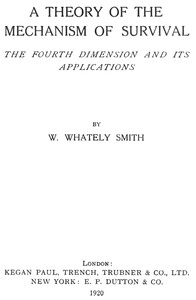
A Theory of the Mechanism of Survival: The Fourth Dimension and Its…
Published in 1920, W. Whately Smith's 'A Theory of the Mechanism of Survival' is a historical curiosity that feels both wildly out of its time and strangely prescient. It sits at a unique crossroads, written when Einstein's theories were still fresh and the boundaries between physics, philosophy, and psychical research were incredibly blurry.
The Story
There isn't a plot in the traditional sense. Instead, Smith builds an argument, piece by piece. He starts with the cutting-edge scientific idea of his day: that our universe has four spatial dimensions, not three. We just can't perceive the fourth one. From there, he makes a huge leap. He suggests that human consciousness, or the 'soul,' might not be an immaterial spirit, but rather an entity that exists in that unseen fourth dimension. Death, then, isn't an ending, but a translation—our consciousness simply shifts its primary existence into that other dimension, which he equates with the afterlife. He uses analogies from geometry (imagine a 2D being trying to understand a 3D cube) to try and make this baffling idea somewhat graspable. The whole book is his attempt to construct a logical, almost mechanical, model for how survival after death could physically work.
Why You Should Read It
Don't read this expecting proof of ghosts. Read it for the sheer audacity of the thought experiment. Smith's passion is palpable. He's not a mystic; he's a man of his scientific era, desperately trying to fit the oldest human question into the newest intellectual framework. The charm—and the friction—comes from watching him stretch the fledgling concept of higher dimensions to its absolute limit. You'll find yourself alternately intrigued by his logic and shaking your head at the leaps of faith disguised as deduction. It's less about whether he's 'right' and more about witnessing a brilliant, forgotten attempt to map the unknown with the tools he had. It makes you think: if we tried to explain the afterlife today, what modern scientific concepts would we bend and twist to do it?
Final Verdict
This book is a niche treasure. It's perfect for history of science buffs, fans of vintage paranormal research, or anyone who loves seeing old, radical ideas. If you enjoy books that explore the fringes where science and speculation collide—think Carl Sagan wondering about alien life, but for the afterlife—you'll find this fascinating. It's not an easy beach read, but as a window into a very specific moment in intellectual history, it's completely absorbing. Approach it with curiosity, not skepticism, and you'll be rewarded with a truly unique perspective from the past.
This text is dedicated to the public domain. Preserving history for future generations.
Jennifer Lopez
9 months agoVery satisfied with the depth of this material.
John Miller
6 months agoI was skeptical about the depth of this book at first, but the way the author breaks down the core concepts is remarkably clear. Simple, effective, and authoritative – what else could you ask for?
Joseph Lopez
11 months agoI stumbled upon this title during my weekend research and the historical context mentioned in the early chapters is quite enlightening. I feel much more confident in my knowledge after finishing this.
Deborah Moore
1 year agoRecommended.



Linda Brown
4 months agoA sophisticated analysis that fills a gap in the literature.