
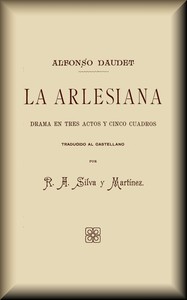
La arlesiana : Drama en tres actos y cinco cuadros by Alphonse Daudet
La Arlesiana (The Woman from Arles) is a three-act play that feels more like a slow-burning fuse than a traditional drama. It’s based on a story from Alphonse Daudet’s collection Lettres de mon moulin, and it was famously turned into an opera by Bizet. But the original play has a raw, quiet power all its own.
The Story
We’re on a farm in Provence. Frédéri, a young farmer, is deeply in love with a beautiful woman from the nearby city of Arles. The catch? She’s already involved with another man and has a, let's say, complicated reputation. Everyone in Frédéri’s life knows this—his tough, practical mother Rosa Mamai; the old shepherd Balthazar; even his simple-minded younger brother, L’Innocent. They’ve all seen the woman and know the truth, but they keep it from Frédéri, hoping his passion will fade.
It doesn’t. Instead, Frédéri sinks into a deep melancholy, refusing to eat or sleep, just pining for his ‘Arlesiana.’ His mother, desperate to save him, arranges for him to marry his faithful childhood friend, Vivette. But when Frédéri learns the full, ugly truth about the woman from Arles, the play drives toward its inevitable, tragic conclusion.
Why You Should Read It
For such a short play, it packs a punch. Daudet doesn’t waste a word. The heat of Provence is almost a character itself, making everything feel heavy and tense. This isn’t really about the mysterious woman—we never even see her. It’s about the wreckage she causes from a distance.
The real star is Rosa Mamai. Her struggle is so relatable: she’d do anything to take away her son’s pain, but she’s powerless against an idea, a fantasy. Frédéri’s love is a kind of sickness, and watching a family try to nurse someone through that is moving and frustrating in the best way. The ending is sudden and brutal, and it stays with you.
Final Verdict
This is perfect for anyone who loves character-driven stories where the biggest battles happen inside people’s heads. If you enjoy classic tales of doomed love but want something grittier than pure romance, give this a shot. It’s also a great, accessible entry point into 19th-century French literature—it’s short, the emotions are huge and clear, and you can read it in one sitting. Just don’t expect a happy ending in the sunshine.
This book is widely considered to be in the public domain. You do not need permission to reproduce this work.
Joseph Harris
8 months agoThe clarity of the introduction set high expectations, and the insights into future trends are particularly thought-provoking. I appreciate the effort that went into this curation.
Susan Moore
6 months agoThe peer-reviewed feel of this content gives me great confidence.
Barbara White
2 years agoThis work demonstrates a clear mastery of contemporary theories.
Ashley Thomas
4 weeks agoI started reading this with a critical mind, the data points used to support the main thesis are quite robust. It definitely lives up to the reputation of the publisher.


Mary Gonzalez
1 month agoAs someone working in this industry, I found the insights very accurate.