
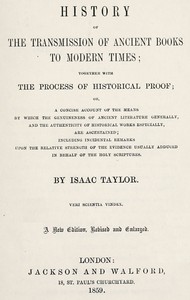
History of the transmission of ancient books to modern times by Isaac Taylor
Let's be clear from the start: this isn't a book about the content of ancient literature. You won't get analysis of Plato's philosophy or Virgil's poetry. Instead, Isaac Taylor focuses on something more fundamental: the physical journey of the books themselves. How did these fragile objects—papyrus, parchment, and early paper—survive fire, flood, war, and neglect to become the edited, printed volumes we read today?
The Story
Taylor acts as a guide, walking us through the major waypoints in a book's perilous life. He starts in the ancient world, where texts were copied by hand in small numbers. He shows how the great library of Alexandria wasn't the only casualty; knowledge was constantly at risk. The narrative then moves to the medieval monasteries, where monks became the unsung heroes of preservation, dedicating their lives to copying texts, letter by letter. Finally, we reach the dawn of the printing press, which didn't end the story but changed the rules of the game, creating new challenges of accuracy and distribution. The 'plot' is the collective, centuries-long effort to pass the baton of written knowledge from one generation to the next without dropping it.
Why You Should Read It
This book changed how I look at every old book on my shelf. It gives you a profound appreciation for the sheer effort and chance involved in bringing ancient voices to the present. Taylor highlights the human element—the scribe with a cramping hand, the scholar hunting for a rare manuscript, the collector who saves a crumbling codex. You realize that our entire connection to thinkers like Cicero or Augustine hangs by a thread that was nearly cut dozens of times. It's a humbling and exciting perspective. It makes history feel tangible, focused on the artifact you can imagine holding.
Final Verdict
Perfect for curious readers who love history, books as physical objects, or a good story about against-the-odds survival. If you've ever enjoyed a museum exhibit on ancient manuscripts or wondered about the work behind a modern critical edition, this is your backstage pass. It's not a light read, but it's a rewarding one. You'll finish it with a new sense of gratitude for every old book that managed to complete its incredible journey to the modern age.
You are viewing a work that belongs to the global public domain. You can copy, modify, and distribute it freely.
Karen Thompson
1 year agoThe layout of the digital version made it easy to start immediately, the way it challenges the status quo is both daring and well-supported. This should be on the reading list of every serious professional.
James Harris
7 months agoHaving followed this topic for years, I can say that it addresses the common misconceptions in a very professional manner. It cleared up a lot of the confusion I had previously.


Jennifer Thompson
1 year agoI was skeptical about the depth of this book at first, but the formatting on mobile devices is surprisingly crisp and clear. It’s hard to find this much value in a single source these days.